
Captain's Brief · Seafarer rights / PD 1727 · 10 min read · Oct 13, 2026
"Bomba, Joke": The Anti-Bomb Joke Law and Its Real Cost to a Seafarer, From NAIA to Your Ship
You're tired, you've packed for nine months, and the cabin crew asks what's in your bag. It's tempting to say something funny. Don't. In the Philippines, the word "bomba" at an airport can get you arrested, even if you add "joke" right after.
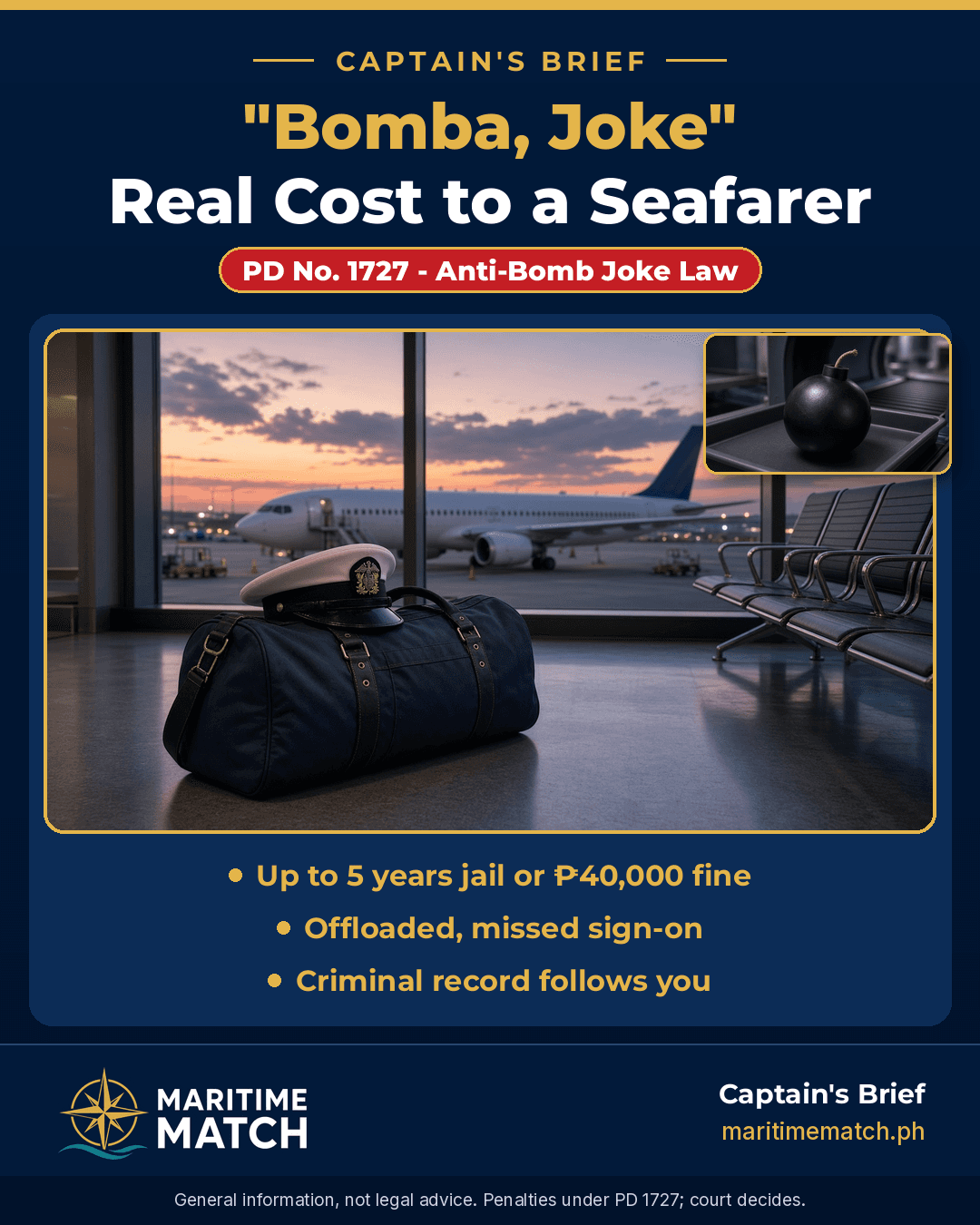
Quick answer: Under Presidential Decree No. 1727, the Anti-Bomb Joke Law, making a false bomb threat or spreading false bomb information can be punished by up to 5 years in prison, a fine of up to ₱40,000, or both.
In 2026 a Filipino seafarer was arrested at NAIA Terminal 2 for saying his bag had a "bomb". A Pasay court later found him guilty and fined him ₱10,000, and he now has a criminal conviction. For a seafarer, the bigger cost can be the missed flight, the missed sign-on and the questions on every visa form afterwards.
Key terms, explained simply
PD 1727 (Anti-Bomb Joke Law). A 1980 Philippine decree that makes it a crime to make a bomb threat or knowingly pass on false information about bombs or explosives. "It was a joke" is not a defence once the words are out.
AVSEGROUP. The PNP Aviation Security Group, the police unit at Philippine airports. They respond to every bomb remark, with explosive ordnance disposal (EOD) teams and sniffer dogs (K9).
Offloaded. Taken off the flight. You lose your seat, and the plane may be delayed while everyone else is searched.
ISPS Code. The International Ship and Port Facility Security Code. It sets security levels and procedures for ships and ports. A bomb threat onboard or at a port gate can trigger those procedures.
Two cases from 2026
NAIA Terminal 2, 26 May 2026: a seafarer. A 26-year-old seafarer was boarding a domestic flight to Butuan. When a cabin crew member asked about the contents of his bag, he said it contained a "bomb", then said he was joking.
- AVSEGROUP bomb disposal and K9 units searched his bag and the area. Nothing was found.
- He was arrested and charged under PD 1727.
- On 10 June 2026, a Pasay Metropolitan Trial Court found him guilty and fined him ₱10,000.
Tacloban (Daniel Z. Romualdez Airport), 1 October 2026: a passenger. A 32-year-old male passenger was boarding a Manila-bound flight. Asked if he had a power bank, he reportedly answered: "Wala naman, pero bomba, joke."
- All passengers were ordered off the plane. Police searched every bag on the tarmac with K9 units. Nothing was found.
- He was held at the Tacloban Airport Police Station, and police were preparing a criminal complaint under PD 1727.
- News reports describe him only as a passenger. We have not confirmed his occupation, and no court outcome had been reported at the time of writing.
Earlier in 2026, police also reported bomb remarks at NAIA in January. In one case, complaints were prepared under both PD 1727 and unjust vexation (Article 287 of the Revised Penal Code). So one remark can lead to more than one charge.
What PD 1727 says
- Section 1: anyone who, by word of mouth or any other means, willfully makes a threat or knowingly spreads false information about an attempt to kill, injure or intimidate people, or to damage property, using explosives or similar devices, can be punished by:
- imprisonment of up to 5 years, or
- a fine of up to ₱40,000, or
- both, at the court's discretion.
- Section 2 of the 1980 text refers to arrest orders, no bail and military courts. That reflects the martial law era and is not how cases are handled today. Bomb-joke cases now go to the regular courts, as the NAIA case did. Ask a lawyer about bail and procedure in your own case.
What happens on the day
Based on what police reported in the 2026 cases:
- The crew reports you immediately. Cabin crew and screeners must treat every bomb remark as real.
- Police and EOD respond. Your bag, and often the whole plane's bags, are searched with K9 units.
- You are taken off the flight. Other passengers may be deplaned and delayed too.
- You may be arrested and held at the airport police station while a complaint is prepared.
- A criminal case follows. It goes to the prosecutor and the court. That means time, lawyers and possibly travel back for hearings.
For a seafarer flying to join a ship, steps 3 to 5 can mean missing your flight and your sign-on.
The cost to a seafarer: table
| Cost | What we know | Status |
|---|---|---|
| Fine | ₱10,000 in the NAIA 2026 case; the law allows up to ₱40,000 | Confirmed (court decision, news reports) |
| Prison | The law allows up to 5 years | Possible, depending on the court; none reported in the 2026 cases |
| Criminal record | A conviction (NAIA 2026 case) | Confirmed |
| Missed flight | Offloaded; flight delayed for search | Confirmed in both 2026 cases |
| Missed sign-on | If you can't fly, the ship may sail without you | Possible; not reported in these cases |
| Ticket and travel costs | You may have to pay for rebooking or flights back for hearings | Possible |
| Agency and contract | The agency may replace you or cancel your deployment | Possible; depends on your agency and contract |
| NBI clearance | A case or conviction may show as a "hit" and need extra steps | Possible; not verified |
| US C1/D crew visa | The US visa form asks if you've ever been arrested or convicted. You must answer yes and explain | Disclosure is required; the effect on approval is up to the consul |
| Extra charges | Unjust vexation was also filed in a January 2026 NAIA case | Possible |
About US visas: the US visa form (DS-160) asks whether you have ever been arrested or convicted of any offence. An arrest counts even if the case was dismissed. Lying on that form can lead to a permanent ban. If you have ever had a case, answer honestly and bring the court papers. We have not confirmed whether a PD 1727 conviction alone makes a seafarer ineligible for a C1/D visa; that is decided case by case.
Never say it: a list for every place you travel
At the airport (check-in, security, immigration):
- Never say "bomb", "bomba", "explosive", "pasabog" or "may granada ako", even as a joke.
- Never joke that your bag is "dangerous" or will "blow up".
- Don't joke about hijacking or "taking over" the plane.
With cabin crew:
- When asked about power banks, lighters or liquids, answer plainly: "Yes, one power bank," or "No."
- Don't say "joke" after anything about bombs. Police treat it as the remark, not the joke.
At port gates and the gangway:
- Answer security guards and ship security officers plainly. Never joke about what's in your bag.
- Don't joke about threats against the ship, the terminal or the crew.
Onboard:
- Never joke about bombs, fires or sabotage on the radio, in messages or in the mess room.
- Group chats and social media count. Police have also warned against bomb remarks online.
The ISPS angle: why ships take it just as seriously
Ships and port facilities run under the ISPS Code. A bomb threat at the gangway, in a port facility or onboard is a security incident. It can mean:
- the ship security officer and port facility security officer must respond and report it
- searches of the ship or terminal, and cargo operations stopped
- a raised security level and delays for the ship
- police involvement in the port state
Even a "joke" can delay a ship and cost the owner money. That can end your contract, and it can follow you in your crew record.
Before you fly: checklist
- Pack early and correctly. Power banks in hand-carry, not checked bags. No lighters or sharp items in hand-carry.
- Know your answers. Be ready to say plainly what's in your bag.
- No jokes about bombs, weapons or hijacking, in person, on the phone or online.
- Remind your batchmates. If you travel as a group, agree on this before you reach the airport.
- Stay calm in long lines and delays. Frustration is when people say things they regret.
- If you are stopped: stay calm, answer truthfully, ask to contact your manning agency, and get legal advice before signing statements.
- If you've ever had a case: tell your agency, and answer visa forms truthfully, with court papers ready.
The bottom line
One word can cost you more than ₱10,000. It can cost you the flight, the ship and the clean record your career depends on. At airports, ports and onboard, take security questions seriously and answer them plainly. Save the jokes for the mess room, and never about bombs.
Facts checked on 13 Oct 2026.
Not confirmed at the time of writing:
- The occupation of the Tacloban passenger and the outcome of that case.
- Whether a PD 1727 case or conviction shows on an NBI clearance, and how it is handled.
- Whether a PD 1727 conviction affects US C1/D visa approval. Disclosure is required, but the effect is decided case by case.
- Any DMW or MARINA advisory on bomb jokes. We found police (PNP) warnings, but no DMW or MARINA reminder.
This guide is general information, not legal advice. If you face a case, talk to a lawyer and your manning agency.
Sources
- Presidential Decree No. 1727 (1980), Lawphil: https://lawphil.net/statutes/presdecs/pd1980/pd_1727_1980.html
- The Manila Times, 29 May 2026, "Seafarer faces charges over bomb joke at NAIA": https://www.manilatimes.net/2026/05/29/news/seafarer-faces-charges-over-bomb-joke-at-naia/2354289
- The Global Filipino Magazine, 29 May 2026: https://theglobalfilipinomagazine.com/it-was-just-a-joke-seafarer-arrested-at-naia-after-bomb-remark-to-cabin-crew/
- The Philippine Star, 17 Jun 2026, "Pinoy sailor fined P10,000 for bomb joke": https://www.philstar.com/nation/2026/06/17/2535734/pinoy-sailor-fined-p10000-bomb-joke
- Malaya Business Insight, 17 Jun 2026, "Seafarer fined P10K for bomb joke at NAIA": https://www.magzter.com/stories/newspaper/malaya-Business-Insight/SEAFARER-FINED-P10K-FOR-BOMB-JOKE-AT-NAIA
- The Manila Times, 3 Oct 2026, "Manila-bound flight disrupted after passenger's bomb joke": https://www.manilatimes.net/2026/10/03/news/manila-bound-flight-disrupted-after-passengers-bomb-joke/2438316
- The Philippine Star, 4 Oct 2026, "Man arrested for bomb joke": https://www.philstar.com/nation/2026/10/04/2560746/man-arrested-bomb-joke
- Brigada News, 5 Oct 2026: https://www.brigadanews.ph/passenger-arrested-after-alleged-bomb-joke-at-tacloban-airport/
- Daily Tribune, 2 Feb 2026, "Think before you joke: PNP cautions travelers over bomb remarks": https://tribune.net.ph/2026/02/02/think-before-you-joke-pnp-cautions-travelers-over-bomb-remarks
- Journal News, PNP warning on bomb jokes: https://journalnews.com.ph/pnp-issues-stern-warning-against-bomb-jokers-anew/
- US Department of State, nonimmigrant visa application (DS-160): https://ceac.state.gov/genniv/