
Captain's Brief · Seafarer rights / Hormuz · 14 min read · Oct 13, 2026
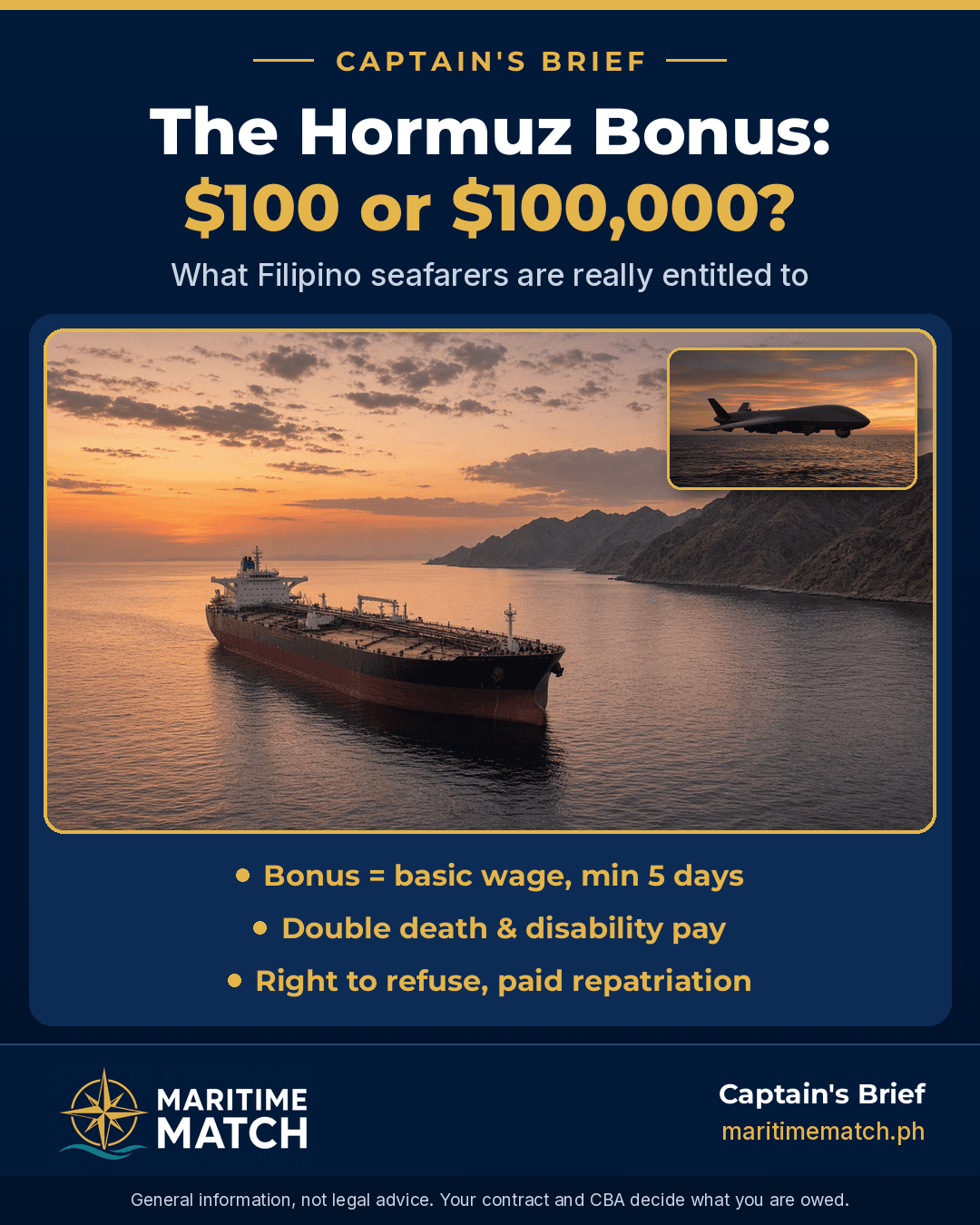
The Hormuz Bonus: $100 or $100,000? What Filipino Seafarers Are Really Entitled To
A number has been going around group chats and social media: a "Hormuz bonus" for crossing the strait. Some posts say US$100. Others say US$100,000. Both can't be right, and neither one tells you what you're actually owed.
This guide sorts it out: what the news reports say, what your contract guarantees, how to refuse a transit if you have to, and what to check before you sign for a Gulf trade.
Quick answer: We found no source for a flat US$100 Hormuz bonus. The trending figure comes from news reports that some tanker owners are offering captains about US$100,000 a month plus about US$50,000 per trip. Those are private offers from individual owners, not a rule.
What you are guaranteed, if you are on an IBF-covered contract, is the IBF warlike area benefit: a bonus equal to your basic wage (minimum 5 days), double death and disability compensation, and the right to refuse with free repatriation plus 2 months' basic wage. As of 13 October 2026 this covers the Persian Gulf, Strait of Hormuz and Gulf of Oman until 0001 UTC on 22 October 2026, unless extended again.
Key terms, explained simply
IBF (International Bargaining Forum). The table where seafarer unions (through the ITF, the International Transport Workers' Federation) and groups of shipowners agree on pay and conditions. Many crew on foreign-flag ships work under an IBF agreement without knowing the name.
CBA (collective bargaining agreement). The union agreement that sits behind your POEA/DMW contract. Your war bonus, compensation and right to refuse come from the CBA, so this is the document that matters.
Warlike operations area. A sea area the IBF has declared dangerous because of armed conflict. Inside it, extra benefits apply. It's different from a "high risk area", which carries smaller benefits (often no right to refuse).
Designation. The official listing of an area, with exact boundaries and start and end dates. IBF designations are short and get extended (or not) every few weeks.
ISPS Level 3. The highest security level under the ship and port security code, used when an incident is likely or about to happen. The IBF requires owners to put security measures equal to Level 3 in place for this area.
Where the "$100" came from
The figure most likely comes from "$100k" being shortened as the story was reshared.
Here's what the news reports say, based on the Financial Times story (week of 5 October 2026) as summarised by Al Jazeera (8 October) and ABC Australia (11 October):
- Tanker captains: the equivalent of about US$100,000 a month, plus about US$50,000 per trip. Normal captain pay is about US$15,000 a month.
- Ratings (normal pay from about US$1,500): double pay in the southern Red Sea and Gulf of Oman, and at least 4 to 6 times normal pay during each Hormuz transit.
- A Chinese crewing firm was reported (via the Wall Street Journal) to be offering up to US$25,000 per round trip.
- Al Jazeera notes many of these crews come from India, the Philippines and China.
Two things to keep in mind:
- The FT based these figures on unnamed people close to tanker owners and crew. They are reported offers, not published rates.
- They are owner by owner. No union, IBF or DMW rule says anyone must pay them. If it's not written into your contract, you can't count on it.
There are also reports, from an Indian seafarers' union, of owners pressuring crew to sail by threatening to replace them or charge them for repatriation. That's why knowing your written rights matters more than the headline number.
Owner offers vs IBF contract benefits
| Reported owner offers | IBF warlike area benefit | |
|---|---|---|
| Who sets it | Individual owners, case by case | IBF agreement (unions and owners) |
| Captain | About US$100,000/month plus about US$50,000/trip (reported) | Bonus equal to basic wage, as for all ranks |
| Ratings | Double pay in Gulf of Oman; 4 to 6 times pay per Hormuz transit (reported) | Bonus equal to basic wage, minimum 5 days, then per day if longer |
| Death and disability | Not stated | Doubled |
| Right to refuse | Not part of the offer | Yes, with repatriation at company cost plus 2 months' basic wage |
| Security | Not stated | Owner must provide security equal to ISPS Level 3 |
| Guaranteed? | Only if written into your contract | Yes, if your CBA follows the IBF |
| How long | Until the owner changes it | Until the designation ends (currently 22 Oct 2026) |
Worked example: a rating on US$1,500 basic
This uses the IBF rule and a 30-day month to get a daily rate. Your CBA may calculate the daily rate differently, so check it.
- Daily basic: US$1,500 / 30 = US$50 a day.
- Short transit (in and out within 5 days): the bonus is paid for the 5-day minimum: 5 x US$50 = US$250.
- Longer stay (say 12 days loading in the Gulf): 12 x US$50 = US$600. The area includes ports, terminals and anchorages, so days alongside count.
- If you refuse: repatriation at company cost plus 2 months' basic: 2 x US$1,500 = US$3,000.
Compare that with the reported owner offer of 4 to 6 times pay during a transit. That's far more money, but only if it's in writing, and it doesn't replace your IBF rights.
How to use your right to refuse, step by step
Under the IBF designation, you can refuse to sail into the warlike area. The DMW has also publicly reminded owners and manning agencies that a Filipino seafarer's decision not to sail through a high-risk area must be respected.
- Find out early. Ask the Master or check the voyage orders as soon as a Gulf call is likely. The right is easier to use before the ship enters the area.
- Check your CBA. Confirm it follows the IBF list and find the war-zone clause. Take a photo of it.
- Tell the Master in writing. A short, polite note: you choose not to sail into the IBF warlike operations area and ask for repatriation under your CBA. Keep a copy.
- Tell your manning agency. Email them the same note, with your name, rank, vessel and date.
- Ask for the compensation in writing. Repatriation at company cost plus 2 months' basic wage.
- If you're pressured or threatened, contact your union (or the ITF), and report to the DMW. Don't sign anything that waives your right to refuse.
- Keep records. Messages, emails, dates and names, in case you need to file a claim later.
Refusing is your right. It is not desertion and should not be treated as a breach of contract.
Before you sign for a Gulf contract: checklist
- CBA war clause: Does the CBA follow the IBF warlike area list? Does it give the bonus, double compensation and right to refuse?
- Bonus in writing: If the agency promises an extra Hormuz bonus, is the amount, and when it's paid, written into the contract or an addendum?
- Security: What measures equal to ISPS Level 3 will the ship have (citadel, guards, extra lookouts, routing)?
- DMW advisory: What's the latest DMW advisory on the Persian Gulf, Hormuz and Gulf of Oman? Are there conditions on deployment or crew change? Check dmw.gov.ph before you fly.
- Waivers: Are you being asked to sign a declaration that gives up your right to refuse? Read it carefully and ask the DMW or your union first.
- Insurance: Is the ship covered for war risks, and does your death and disability cover double in the area? Ask who your P&I club is.
- Designation dates: When does the IBF designation end? Benefits only apply while it's in force.
- Family: Does your family know who to call at the agency and at the DMW/OWWA if something happens?
Safety before money
In October alone, several ships have been hit in and around the strait, and Filipino crews have been sent home after their vessels were damaged. A large bonus doesn't change the risk.
Take the transit only if the terms are in writing, the security is real and you've made the choice yourself. If not, you have the right to say no, and the right to go home paid.
Facts checked on 13 Oct 2026. Pay rules change quickly. Before you sign or sail, check the current IBF list on the ITF Seafarers site and the latest DMW advisories.
Not confirmed at the time of writing:
- Whether the IBF will extend the Hormuz designation past 0001 UTC 22 October 2026.
- A newer DMW advisory (reported as Advisory No. 58, 2026) updating the IBF list. We could not open the official text. We also found no DMW total ban on Hormuz deployment.
- The owner pay figures. They come from unnamed sources quoted by the Financial Times and repeated by other outlets. They are not published rates.
This guide is general information, not legal advice. Your own contract and CBA decide what you are owed.
Sources
- IBF List of Designated Risk Areas (as of 1 October 2026), ITF Seafarers: https://www.itfseafarers.org/sites/default/files/node/resources/files/IBF%20List%20of%20designated%20risk%20Areas%20with%20applicable%20benefits%20%28as%20of%201st%20of%20October%202026%29.pdf
- IBF List of Designated Risk Areas (as of 17 September 2026): https://www.itfseafarers.org/sites/default/files/node/resources/files/IBF%20List%20of%20designated%20risk%20Areas%20with%20applicable%20benefits%20%28as%20of%2017th%20of%20September%202026%29.pdf
- DMW Advisory No. 51, Series of 2026: https://wcms.dmw.gov.ph/uploads/DMW_ADVISORY_51_2026_c9d3de9ce0.pdf
- DMW advisories index (2026): https://dmw.gov.ph/resources/issuances/advisories?year=2026
- World Ports Organization, "DMW reiterates Filipino seafarers' right to refuse voyages through high-risk areas": https://www.worldports.org/dmw-reiterates-filipino-seafarers-right-to-refuse-voyages-through-high-risk-areas/
- Financial Times (paywalled): https://www.ft.com/content/0d665e5b-d8c8-4f1e-acf5-bba7193b4e6e
- Al Jazeera, 8 Oct 2026: https://www.aljazeera.com/news/2026/10/8/the-hormuz-bonus-sailor-salaries-soar-for-transits-amid-iran-war
- ABC Australia, 11 Oct 2026: https://www.abc.net.au/news/2026-10-11/sailors-offered-bonuses-to-cross-strait-of-hormuz-in-iran-war/107248044
- The Manila Times, 10 Oct 2026, "17 Filipino seafarers return home after Strait of Hormuz attacks": https://www.manilatimes.net/2026/10/10/news/17-filipino-seafarers-return-home-after-strait-of-hormuz-attacks/2443008