
Captain's Brief · Seafarer rights / US ports · 14 min read · Oct 14, 2026
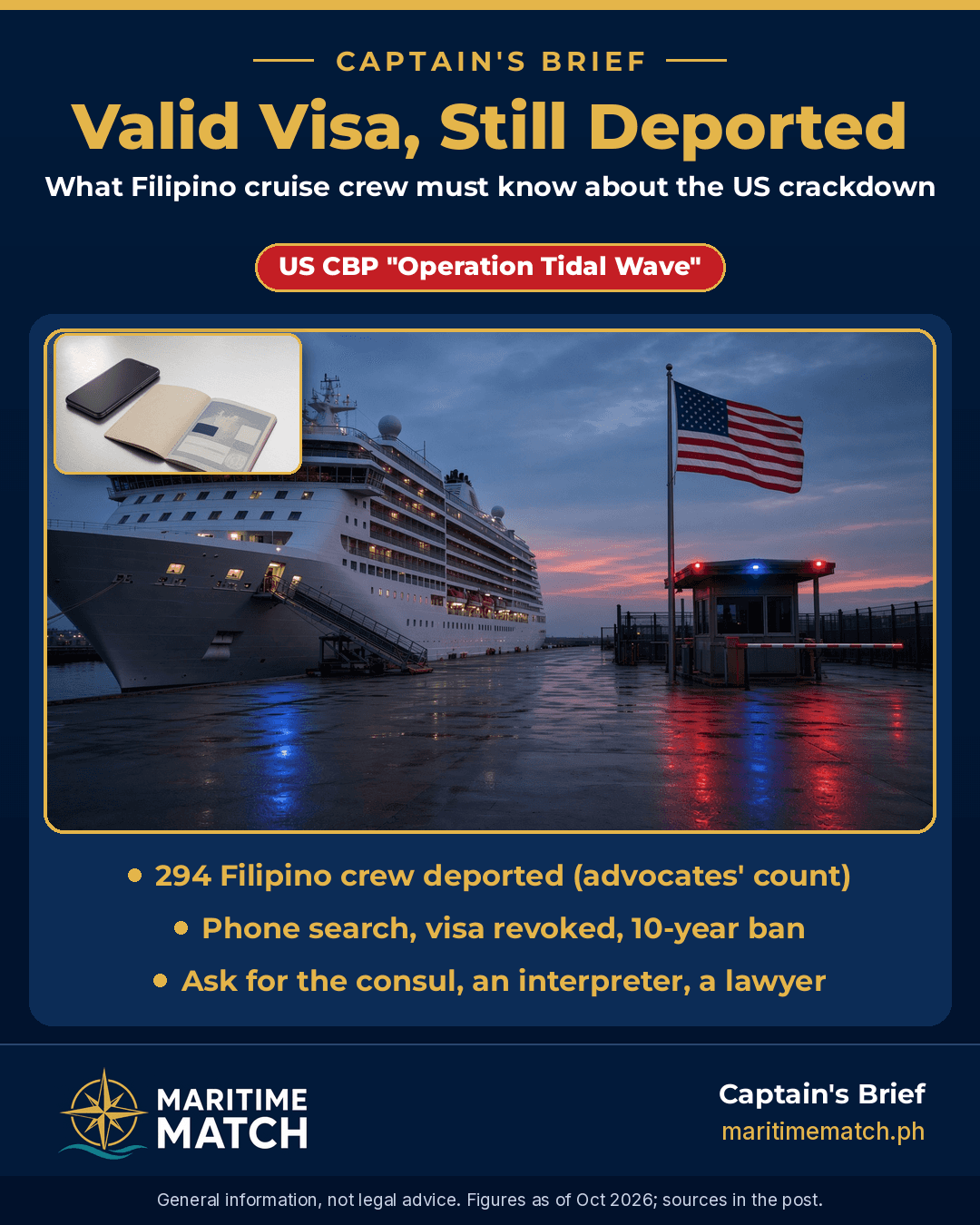
Valid Visa, Still Deported: What Filipino Cruise Crew Should Know About the US "Operation Tidal Wave" Crackdown
You have a valid C1/D visa, a clean record and years on the same cruise line. Then the ship docks in a US port, officers knock on your cabin door, and by the next day you are on a plane to Manila with a revoked visa. As of October 2026, this has happened to hundreds of Filipino crew.
This guide explains what is happening, what US border officers can and cannot do, what to do before your next US port call, and who to call if it happens to you or a crewmate.
Quick answer (as of Oct 2026): US Customs and Border Protection (CBP) runs "Operation Tidal Wave", which it says targets cruise crew linked to child sexual abuse material. Advocacy groups count 294 Filipino seafarers deported since April 2025. Many say they held valid C1/D visas, were never charged with a crime and were never shown evidence.
At a US port, CBP can search your phone, revoke your crew landing permit, and remove you without a court hearing, often with a 10-year ban. You still have the right to ask for the Philippine consulate, ask for an interpreter, and refuse to sign papers you don't understand. DMW's advice: if questioning turns towards a criminal accusation, ask for a lawyer.
Key terms, explained simply
CBP (US Customs and Border Protection). The US agency that checks people and goods at US ports and airports, including crew on ships calling at US ports.
C1/D visa. The US transit and crew visa most seafarers carry. It lets you work on a ship in US waters and transit the US, but it does not guarantee you can step ashore.
Conditional landing permit (Form I-95). The permission CBP gives a crew member to go ashore temporarily. Under US law (INA Section 252), an officer can revoke it if they decide you are not a genuine crew member or won't leave with your ship, and can remove you without a hearing before a judge.
Removal / deportation. Being sent out of the US by the authorities. A removal can carry a bar on returning. CBP says child sexual abuse material cases carry 10-year inadmissibility.
Consular notification. Under Article 36 of the Vienna Convention on Consular Relations, a foreign national who is detained can ask that their country's consulate be told.
What is happening: the numbers (as of Oct 2026)
| Date | What happened | Source |
|---|---|---|
| Apr 2025 to Oct 2026 | Advocacy groups count 294 Filipino seafarers deported by CBP (up from 270 counted at a September forum) | Center for Migrant Advocacy, via BusinessMirror, 2 Oct 2026 |
| Apr 2026 | San Diego (Phase 1): enforcement action against 27 crew from six vessels | CBP, 25 Sep 2026 |
| Jun to Jul 2026 | San Juan (Phase 2): 14 crew removed, one case accepted for federal prosecution | CBP, 25 Sep 2026 |
| Mid-Aug to Sep 2026 | Boston: 87 cruise crew removed in total | CBP, 25 Sep 2026 |
| 20 Sep 2026 | Six Filipinos removed from the cruise ship Breakaway in Boston. CBP says they admitted past possession during interviews; their landing permits were revoked | CBP, 25 Sep 2026 |
| 21 Sep 2026 | Sen. Risa Hontiveros delivers a privilege speech on deported seafarers | BusinessMirror; Rappler |
| 5 Oct 2026 | Seven more Filipino crew taken by CBP in Boston from different cruise ships and immediately sent home | GMA News, 8 Oct 2026 |
| 12 to 13 Oct 2026 | DMW announces a team to Washington, D.C. to set up legal help, plus Action Fund aid and job help | BusinessMirror, 12 and 13 Oct 2026 |
Two sides of the story.
- CBP's position: the operation is "intelligence-based" and targets crew linked to child sexual abuse material. It is run with Homeland Security Investigations and the Internet Crimes Against Children Task Force. CBP says Boston enforcement will continue through the rest of the US fiscal year.
- What deported crew and advocates report: they were interrogated on board, had cabins searched and phones seized, were handcuffed, were pressured to sign papers they didn't understand, and got no lawyer and no consul. Many say they were never shown evidence. In some cases the papers given to them cited being "likely to jump ship" rather than any crime.
We can't judge individual cases. This guide is about due process and protecting yourself, whatever the accusation.
Why valid C1/D holders are affected
A valid visa lets you apply to land. It does not guarantee you will be allowed ashore. That decision is made by the CBP officer at each port call.
- Your landing permit can be revoked on the spot. Under INA Section 252(b) and 8 CFR 252.2, an officer can revoke a crew member's conditional landing permit, take the crew member into custody without a warrant, and arrange removal at the shipowner's expense. For crew landed since April 1997, removal happens without a hearing, except for asylum claims.
- The visa itself can be cancelled. Crew report C1/D visas stamped "revoked" during removal. Some seafarers already back home have received revocation notices by email (as of Oct 2026).
- People are picked out, not chosen at random. In a 2025 Senate hearing, DMW said CBP boarded with names and email addresses already in hand and went straight to specific cabins.
- There can be a re-entry ban. CBP says child sexual abuse material cases carry 10-year inadmissibility. Deported crew report receiving 10-year bar orders.
What CBP can do at a US port
Based on CBP's own published rules (as of Oct 2026):
- Search your phone and laptop without a warrant. All travellers, including crew, are subject to inspection. A basic search is an officer scrolling through your device by hand. An advanced search connects equipment to copy or analyse it and, under CBP policy, needs reasonable suspicion and a senior manager's approval.
- Ask for your passcode. If you refuse to unlock a device, CBP can hold the device, and for a non-US citizen it can count the refusal in deciding whether to admit you.
- Search only what is on the device. CBP says officers may not use your phone to open data stored only in the cloud, and will switch the device to airplane mode first.
- Keep copies for up to 15 years if officers find evidence of a violation, or information relevant to enforcement.
- Give you a tear sheet. CBP policy says you should be told about the device search before it starts, often with a printed "tear sheet" explaining your rights and how to complain.
- Revoke your landing permit and remove you (see above).
CBP searched devices of 55,318 travellers in US fiscal year 2025, less than 0.01% of arrivals. But for crew named in an operation, a search should be expected.
Before every US port call: checklist
Your phone and devices
- Keep only lawful content. Possessing child sexual abuse material is a serious crime in the US and the Philippines. Never download, keep or forward it. If someone sends it to you, don't open it, don't forward it, and report it to your officer or HR.
- Leave group chats that share shady content. Files sent to you in group chats can auto-save to your phone.
- Turn off auto-download for photos and videos in WhatsApp, Messenger, Viber and Telegram.
- Clean old downloads and unknown files. Don't click strange links or emails offering "free videos".
- Know what's on any phone, laptop or USB you carry, including second-hand devices and ones borrowed from crewmates.
- Never use a crewmate's account or let others use yours.
Your papers
- Photograph your passport, C1/D visa, seaman's book, contract and DMW/POEA contract, and save them to your cloud and to a family member.
- Save key numbers on paper, not only on your phone: your manning agency, the Philippine Embassy and nearest consulate, and your union. Your phone may be taken.
- Tell family your ship, ports and agency contact.
If CBP comes to your cabin or calls you in
- Stay calm, be polite and tell the truth. Never lie to a US officer; that can make things worse.
- Ask for an interpreter if you don't fully understand English questions.
- Ask that the Philippine consulate be told (Vienna Convention, Article 36). Say clearly: "I want the Philippine consulate notified."
- Don't sign anything you don't understand. Ask what it is, ask for a copy, and ask for time to read it. Crew reported signing forms that turned out to admit things they had never been accused of.
- If questions point to a crime, ask for a lawyer. This is DMW Secretary Cacdac's advice (Oct 2026).
- Ask for copies of every paper you are given or sign, and the name and badge number of the officers.
- Tell your HR or the ship's crew office and ask them to call your agency and the consulate.
After removal
- Keep every document you are handed (removal orders, bar notices, visa revocation).
- Report to DMW and OWWA at the airport on arrival, and to your agency within days.
- Write down what happened while you remember it: dates, names, ship, port, what was said and signed.
This checklist is general information, not legal advice.
Who to contact
| Who | Why | How (as of Oct 2026) |
|---|---|---|
| Philippine Embassy, Washington D.C., or nearest Philippine Consulate General (with its Migrant Workers Office) | Consular notification, welfare checks, telling your family and employer | Ask CBP to notify them. Find the post on the DFA website |
| DMW (Department of Migrant Workers) | Case help, Action Fund aid, job placement, legal help being set up | Official DMW website and Facebook page (dmw.gov.ph) |
| OWWA | Welfare, airport help on arrival, case management, retraining | OWWA hotline 1348; Airport Arrival Assistance Desk after Customs at NAIA T1 and T3 |
| Your manning agency and the cruise line HR | Your contract, wages owed, flights, possible redeployment | Your agency's 24/7 number |
| Your union (e.g. AMOSUP or the union named in your CBA) | Contract and CBA rights, legal support | Number in your CBA or union card |
| Advocacy groups | Documenting cases, legal and psychosocial support | Center for Migrant Advocacy-Philippines; Pilipino Workers Center (Los Angeles) |
The Philippine consulate has said it cannot overturn a US admissibility decision. It can do welfare checks, tell your family and employer, and pass on urgent medical concerns (Consulate General in Los Angeles, May 2026).
What happens to your contract and your next job
- The contract usually ends early. Being removed from the ship ends your current work. Ask your agency in writing about wages owed, leave pay and repatriation costs. Under US rules, removal costs fall on the shipowner or transport line.
- Rehiring is the hardest part. Advocates say principals are wary of crew with revoked US visas, even for non-US routes. One deported waiter told BusinessMirror: "The manning agencies may still consider us, but when it reaches the principals, they no longer want us."
- Some agencies have helped. Rappler reported crew redeployed to Europe or non-US ships through agencies that backed them.
- A US ban can't be lifted by Manila. DMW Secretary Cacdac (13 Oct 2026): "If there is a ban, we cannot do anything." DMW is instead looking at non-US cruise routes, local hotel and hospitality jobs, and livelihood or business programmes.
- Future visa forms. US visa forms ask about past removals and visa refusals. Always answer truthfully and keep your documents.
What the government is doing (as of Oct 2026)
- Senate: on 21 Sep 2026, Sen. Risa Hontiveros delivered a privilege speech asking DMW and DFA to account for every deported seafarer, check whether the consulate was notified in each case, and strengthen consular intervention. She said "the fight against child sexual abuse and the protection of due process are not opposing principles."
- Embassy: Ambassador Jose Manuel Romualdez said the Embassy will engage US authorities and work with DMW on legal representation for affected seafarers (BusinessMirror, 2 Oct 2026).
- DMW: on 12 and 13 Oct 2026, DMW announced that Undersecretaries Bernard Olalia and Felicitas Bay will lead a team to Washington, D.C. to set up "concrete legal assistance". It is also giving Action Fund (AKSYON) aid to an estimated 200 to 300 deported seafarers and helping with jobs here and abroad.
- OWWA: at a 21 Sep 2026 forum, OWWA committed to individual case management and announced skills training for land-based jobs (virtual assistant, barista, digital content) (Rappler).
- Embassy advisory: the Philippine Embassy in Washington has warned Filipinos in the US and on ships in US waters that US law criminalises possessing, viewing or sharing child sexual abuse material. It added that anyone who feels wrongly accused may seek redress and should contact the Embassy, the nearest Consulate General and the Migrant Workers Office (Facebook advisory, reported by BusinessMirror, July 2025).
The bottom line
A valid visa isn't a shield at a US port. Keep your phone clean and your papers backed up. If CBP calls you in, stay calm and truthful, ask for an interpreter, the consulate and a lawyer, and don't sign what you don't understand. If it happens to a crewmate, help them get word to their agency, the consulate and their family.
Facts checked on 14 Oct 2026.
Not confirmed at the time of writing:
- The total of 294 is an advocacy-group count (CMA and PWC), not an official US or Philippine government figure. DMW has cited "200 to 300", and the Ambassador reportedly cited 239.
- We found no formal DMW or DFA advisory issued in Sep to Oct 2026. The Embassy advisory cited above was reported in July 2025.
- Whether the DMW legal-aid team has reached Washington, and how crew can apply for it.
- The status of the AKSYON Fund. Advocates told Rappler it "dried up"; DMW says it is distributing Action Fund aid.
- Individual allegations in news reports are the seafarers' own accounts and have not been tested in court.
This guide is general information, not legal advice. If you are detained or accused, ask for a lawyer and contact your consulate and agency.
Sources
- US CBP, 25 Sep 2026, "Operation Tidal Wave in Boston Leads to 87 Cruise Ship Crew Removals": https://www.cbp.gov/newsroom/national-media-release/operation-tidal-wave-boston-leads-87-cruise-ship-crew-removals-cbp
- US CBP, "Border Search of Electronic Devices at Ports of Entry" (updated 4 Aug 2026): https://www.cbp.gov/travel/cbp-search-authority/border-search-electronic-devices
- 8 U.S. Code § 1282 (INA Section 252), conditional permits to land: https://www.law.cornell.edu/uscode/text/8/1282
- 8 CFR 252.2, revocation of conditional landing permits: https://www.ecfr.gov/current/title-8/chapter-I/subchapter-B/part-252/section-252.2
- GMA News, 8 Oct 2026, "7 Filipino cruise seafarers arrested in Boston, deported to Philippines": https://www.gmanetwork.com/news/pinoyabroad/dispatch/1005196/7-filipino-cruise-seafarers-arrested-in-boston-deported-to-philippines/story/
- Rappler, 27 Sep 2026, "Valid visas, baseless claims: The aggressive deportation of Filipino seafarers": https://www.rappler.com/people/newsmakers/filipino-seafarers-united-states-deportation/
- BusinessMirror, 2 Oct 2026, "294 Filipino seafarers deported by US border authorities since Trump crackdown, NGO says": https://businessmirror.com.ph/2026/10/02/294-filipino-seafarers-deported-by-us-border-authorities-since-trump-crackdown-ngo-says/
- BusinessMirror, 2 Oct 2026, "PH pursues diplomatic, legal remedies for deported Filipino seafarers in US": https://businessmirror.com.ph/2026/10/02/ph-pursues-diplomatic-legal-remedies-for-deported-filipino-seafarers-in-us/
- BusinessMirror, 12 Oct 2026, "DMW to help 200 deported seafarers": https://businessmirror.com.ph/2026/10/12/dmw-to-help-200-deported-seafarers/
- BusinessMirror, 13 Oct 2026, "DMW sending team to Washington to aid deported Filipino seafarers": https://businessmirror.com.ph/2026/10/13/dmw-sending-team-to-washington-to-aid-deported-filipino-seafarers-local-jobs-eyed-amid-us-ban/
- Inquirer, 13 Aug 2025, "DMW: Deported Filipino seafarers 'not randomly selected' in US raids": https://globalnation.inquirer.net/288031/deported-filipino-seafarers-not-randomly-selected-in-us-raids
- BusinessMirror, 21 Jul 2025, "'We were detained like criminals'" (includes the Philippine Embassy advisory): https://businessmirror.com.ph/2025/07/21/we-were-detained-like-criminals-18-pinoy-cruise-ship-workers-deported-from-us/