
Captain's Brief · Disability benefits / POEA-SEC · 10 min read · Nov 10, 2026
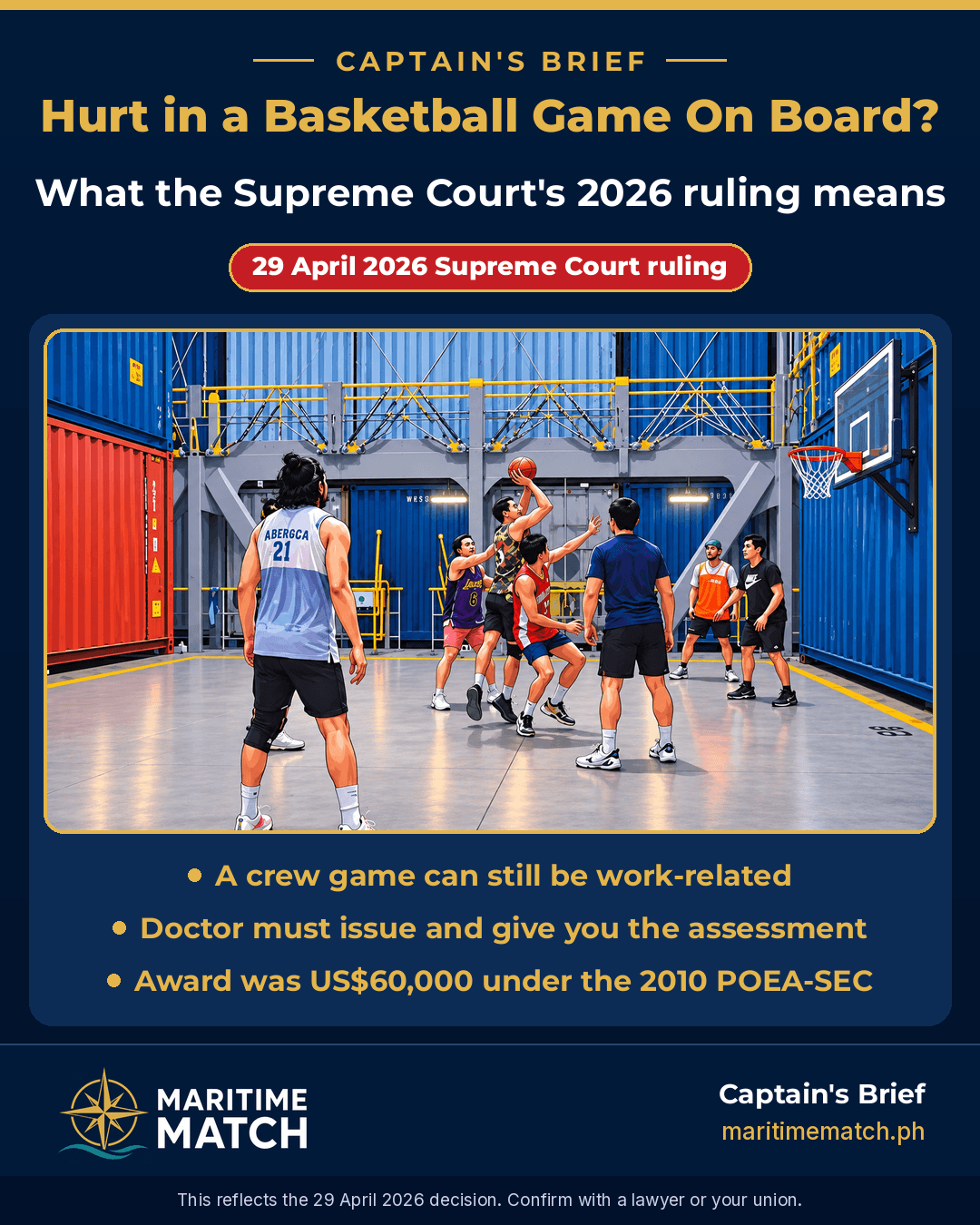
Hurt During a Basketball Game On Board? What the Supreme Court's 2026 Ruling Means for Filipino Seafarers
Kabaro, a crew basketball game is ordinary life at sea. If you get hurt playing, some agencies will say it is not work-related because you were off duty. On 29 April 2026 the Supreme Court said that is not automatically so.
This guide explains Arriesgado v. Multinational Maritime, Inc., G.R. No. 275424 — what the Court held, what it awarded, and a practical checklist if you are injured on board. Every point below was checked against the full decision on Lawphil.
Quick answer: The Court held that an oiler's injury during a basketball game between the ship's deck and engine teams was work-related. Seafarers must live on the ship, so an injury during employer-sanctioned recreation can still arise in the course of employment, unless the employer proves a willful or criminal act under the POEA Standard Employment Contract (POEA-SEC).
The company-designated doctor must issue a final, complete and definite assessment of your fitness or disability, and must give it to you, generally within 120 days from repatriation (up to 240 days if there is a sufficient reason to extend). If that does not happen, the disability can become total and permanent by operation of law.
In this case the Court awarded US$60,000 under the 2010 POEA-SEC, not the higher CBA figure the seafarer had claimed; a sickness-allowance differential; and ₱50,000 in nominal damages because copies of the medical reports were not given to him when he asked. Attorney's fees and moral and exemplary damages were denied. This reflects the 29 April 2026 decision. Confirm with a lawyer or your union before you rely on it.
Key terms, explained simply
Work-related injury. Under the 2010 POEA-SEC, an injury "arising out of and in the course of employment." You do not have to be on watch when it happens.
Bunkhouse rule. Because a seafarer must live on the employer's ship, an injury on board can still be in the course of employment, including after regular hours.
Personal comfort doctrine. Short breaks and employer-allowed recreation that keep you able to work do not automatically take you out of employment.
What happened, in brief
The seafarer was hired in October 2020 as an oiler, basic wage US$641 a month, under the 2010 POEA-SEC and a JSU-AMOSUP CBA. On 10 January 2021, during a basketball game between the deck and engine teams, he was elbowed in the left abdomen, felt severe pain and shortness of breath, and reported it to the duty officer.
He was later examined in Yokohama, declared unfit for duty, and medically repatriated on 25 January 2021. He contacted the agency the next day to see the company doctor, but a COVID-19 quarantine the company itself required delayed the first visit to 1 February 2021. He attended follow-ups for months. On 23 April 2021 the company doctor, noting that pain continued, told him to talk to the agency about future treatment. The seafarer then saw his own doctor and, in writing, asked for a third-doctor referral and for copies of his medical reports under POEA-SEC Section 20(F). The company doctor's "final" report, dated 12 August 2021, questioned his motives, said the injury would not make him unfit once treatment was completed, and was addressed to the agency and its counsel, not to him.
A labor arbiter dismissed the claim. The NLRC awarded US$104,866 under the CBA, plus attorney's fees. The Court of Appeals reversed. The Supreme Court partly granted the seafarer's petition.
Why the Court said the basketball injury was work-related
The Court applied the bunkhouse rule and the personal comfort doctrine, as it had in the earlier basketball case Arguilles v. Wilhelmsen Smith Bell Manning, Inc. A seafarer has to stay on the ship for the whole contract. If you are hurt during ordinary comfort or during recreation the employer expressly or impliedly allows to improve crew well-being, the injury can be work-related.
The Court also pointed to Employees' Compensation Commission Board Resolution No. 24-12-40 (12 December 2024): injuries seafarers sustain during free time or after regular hours while on board, including resulting disability or death, may be compensable, subject to the usual limits (intoxication, willful intention to injure, or notorious negligence).
Under POEA-SEC Section 20(D), there is no compensation if the employer proves the injury came from your willful or criminal act or intentional breach of duty. The company did not prove that here; it had admitted the game was a recreational activity for the crew.
How this differs from Guerrero. In Guerrero v. Philippine Transmarine Carriers, Inc., the Court denied benefits to a casino dealer hurt while working out in the ship's gym on his own, for his own leisure. That case also involved conflicting stories about the injury, a disability argument raised late, and an independent report not backed by proper tests — not the facts here. The employer argued that playing basketball was not part of an oiler's job. The Court rejected that as the test. Work-relatedness is governed by the POEA-SEC, not by whether sport is written into the CBA as a lodging benefit.
The company doctor must issue the assessment — and give it to you
Citing Elburg, Pastrana and Ampo-on, the Court repeated that the company-designated physician must issue a final, complete and definite assessment within 120 days from repatriation, or within 240 days if the extension is justified. Here, the 120th day was 25 May 2021. The 12 August 2021 report was late, and it failed as an assessment: it did not clearly state fitness or a disability grade, and mainly argued that the seafarer was malingering. If the doctor believed that, the Court said, he should still have issued a complete and definite assessment within the period.
Citing Gere, the Court stressed that the doctor must not only issue the assessment but give it to the seafarer. The reports here were addressed to the agency, not to him, despite his written request. That violated POEA-SEC Section 20(F): when requested, "the seafarer shall be furnished a copy of all pertinent medical reports or any records at no cost to the seafarer."
The seafarer had also asked for a third doctor. The Court noted that an employer may, in principle, wait for the independent doctor's report before starting that referral. But without a valid company assessment given to the seafarer, there was "nothing to contest." The disability became total and permanent by operation of law. The Court gave no weight to the independent doctor's report, which it called vague and lacking scientific basis. That did not defeat the claim.
He was not guilty of medical abandonment: he had attended follow-ups until 23 April 2021, when the company doctor sent him back to the agency. Hiring a lawyer and writing a demand letter is not the same as filing a case; the complaint was filed on 9 November 2021, after the 120-day period. On the three-day rule after repatriation, the Court found substantial compliance: he called the agency the next day, and the delay was the company's own quarantine instruction.
What the Court awarded — and what it refused
| Item | Result in this case |
|---|---|
| Disability benefits | US$60,000 under Section 32 of the 2010 POEA-SEC, paid in pesos at the rate on the date of payment |
| Higher CBA amount (US$104,866) | Denied. The CBA required a company-nominated doctor's disability or unfitness finding, which was never properly issued |
| Sickness allowance | US$2,564 (US$641 × 4 months / 120 days), less ₱91,575.65 already paid |
| Nominal damages | ₱50,000, for not giving him his medical records when he asked, and for late payment of the second sickness-allowance tranche |
| Moral and exemplary damages | Denied. No bad faith: a genuine, though mistaken, belief the injury was not work-related, and the company had paid for treatment |
| Attorney's fees | Denied (the NLRC award was deleted) |
| Medical and transport reimbursement | Denied — no receipts were submitted |
| Interest | 6% a year from finality of the decision until full payment |
| Who pays | The manning agency, the foreign principal, and the agency's corporate officers, jointly and severally |
What this ruling does not mean
- It is not a blanket rule that every injury during free time is compensable. The Court looked at a crew game the employer treated as recreation for the seafarers' well-being, and at the absence of a willful or criminal act.
- It does not overrule Guerrero. A purely personal gym workout, on your own, can still be treated differently, especially if the injury story is inconsistent or the medical evidence is weak.
- It does not mean you will get the higher CBA figure. This seafarer claimed US$104,866 and received US$60,000 under the POEA-SEC, because the CBA's own conditions were not met.
- It does not let you skip company-doctor appointments. Failure to report as required can forfeit a claim. He won the abandonment argument because of the record in his case.
- It does not mean a thin second-doctor certificate will be believed. The Court rejected the independent report here. A second opinion needs proper examinations, not a short "unfit for duty" letter.
- It does not replace legal advice. This seafarer was hired in 2020, so the 2010 POEA-SEC applied. Your SEC, CBA and later rules may differ.
If you are injured on board: a checklist
On the ship
- Report the injury at once to the duty officer or the Master, even if it happened during a game, gym time or a rest hour
- Ask that it be entered in the logbook or accident report, and get a copy if you can
- Accept first aid, and ask for a copy of any onboard or shore medical notes
- Note the date, time, place, what you were doing, and who saw it
After repatriation
- Contact the agency and see the company-designated doctor within three working days, or as soon as the company will receive you. If they delay you, keep that instruction in writing
- In writing, request copies of all medical reports and records, at no cost, under POEA-SEC Section 20(F). Follow up until you have them
- Go to every scheduled follow-up. If you cannot attend, say so in writing and reschedule
- Keep receipts for medicines, tests and transport — the Court denied reimbursement where there were none
- Track 120 days from the date of repatriation. If treatment is still ongoing, ask in writing whether the company is extending to 240 days, and why
- Ask in writing for the final, complete and definite assessment of your fitness or disability grade, given to you, not only to the agency
- If you disagree with a real, timely assessment, see a qualified specialist, obtain a properly supported report, give a copy to the agency, and request a third doctor in writing
- Check your SEC and CBA for sickness allowance: at least once a month, for up to 120 days
- Before you sign a quitclaim or a small settlement, read it carefully and consider advice from your union or a lawyer
This guide is general information, not legal advice. It reflects the Supreme Court decision of 29 April 2026, read on 10 November 2026. Confirm with a lawyer, your union or your licensed manning agency before you act.
Download Maritime Match on Google Play: https://play.google.com/store/apps/details?id=ph.maritimematch.app App Store: https://apps.apple.com/ph/app/maritime-match/id6809177839
Sources (read 10 November 2026)
- Arriesgado v. Multinational Maritime, Inc., G.R. No. 275424, 29 April 2026 (Supreme Court, First Division), Lawphil: https://www.lawphil.net/judjuris/juri2026/apr2026/gr_275424_2026.html