
Captain's Brief · Claims / Magna Carta of Filipino Seafarers · 6 min read · Nov 22, 2026
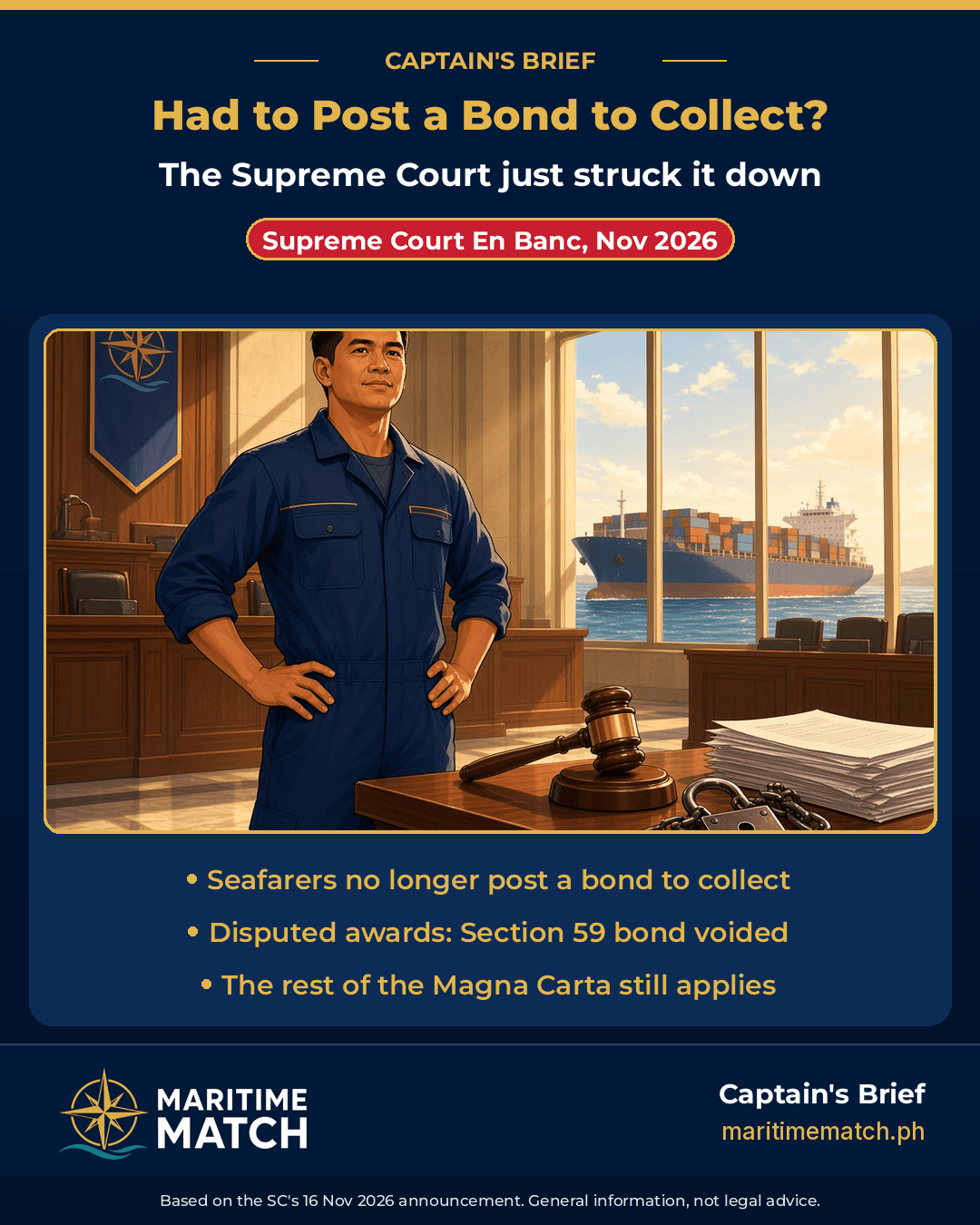
You Won Your Case but Had to Post a Bond to Collect? The Supreme Court Just Struck That Down
You fought a claim, and the labor arbiter, the NLRC or the voluntary arbitrator ruled in your favor. Then the company appealed. Under the Magna Carta of Filipino Seafarers, you could collect only part of your award right away. For the disputed amounts and damages, you first had to post a bond.
The Supreme Court has now struck that bond down.
Quick answer: At its 11 November 2026 session, the Supreme Court En Banc declared Section 59 of Republic Act No. 12021 unconstitutional and void insofar as it required seafarers to post a bond before executing disputed monetary awards and damages pending appeal or judicial review. The Court said the bond violated due process and equal protection. It also voided the related DOLE rules, the use of the DMW's AKSYON Fund to pay bond premiums, and Section 60's 10% cap on lawyers' fees. The rest of the Magna Carta stays valid and enforceable. The full decision has not been published yet, so confirm with a lawyer or your union before you rely on this.
What the Court decided
The case is Matula et al. v. The Executive Secretary et al., G.R. No. 278986, consolidated with G.R. Nos. 279373, 279790, 280040 and 280626. Five petitions were filed by seafarers, labor organizations and maritime schools. The decision was written by Associate Justice Maria Filomena D. Singh, and the petitions were partially granted.
According to the Supreme Court's own briefer, the Court:
- Struck down the bond in Section 59. Under that section, awards for wages, statutory benefits and undisputed amounts could be executed immediately, but disputed amounts and damages could be executed during an appeal only if the seafarer posted "a sufficient bond to ensure the full restitution of those amounts." In the Court's words, the bond "imposed a financial burden on seafarers seeking to enforce favorable labor judgments and subjected them to a disadvantage not similarly imposed on other workers."
- Voided the AKSYON Fund payment for bond premiums. Using public money to pay private bond premiums did not meet the constitutional rule that public funds serve a public purpose.
- Voided Sections 4 and 5, Rule III of DOLE Department Order No. 247, s. 2025, insofar as they implemented the bond.
- Voided Section 1, Rule XXII of the IRR, insofar as it applied Section 59 to complaints filed on or after the law took effect, because it went against Section 94, which protects the rights seafarers already had before the Magna Carta.
- Voided Section 60 of RA 12021 and Section 4 of RA 10706 (the Seafarers Protection Act), insofar as they regulated the practice of law, including the 10% ceiling on fees and the required notarized certifications and undertakings. The Court said Congress can act against ambulance chasing, but regulating lawyers belongs to the Supreme Court.
The Court recognized the government's goal of stopping ambulance chasing and protecting the industry from awards that are never paid back. It found that those goals "did not justify the challenged restriction on the execution of monetary awards."
Why it matters if you have a pending claim
- A favorable award is easier to enforce during an appeal. You no longer have to find money for a bond before asking for execution of the disputed amounts and damages. As UK P&I, which insures shipowners, told its members, a disputed award "may be enforced while an appeal is ongoing without the security previously required."
- Winning at one level is still not the end. The company can still appeal or ask for judicial review, and a higher court can still reverse or reduce an award. The ruling removes the bond. It does not make a decision final.
- Lawyers' fees are now a question for the Supreme Court's own rules. The 10% cap in Section 60 is gone because only the Court can regulate lawyers. Read any fee agreement carefully before you sign, and ask questions if the percentage or the deductions are unclear.
What still applies
- The rest of the Magna Carta. The Court upheld the law's passage and its maritime education rules (Sections 75, 76 and 78), including the ban on charging tuition for third-party shipboard training.
- Immediate execution of the undisputed parts. Section 59 still says wages, statutory benefits and admitted amounts are "immediately executory even pending appeal or judicial review."
- The same forums. Claims still go through the labor arbiter and NLRC, voluntary arbitration through the NCMB, and the DMW where it has jurisdiction.
- Medical deadlines. For disability claims, the company-designated doctor must still give you a final, complete and definite assessment, generally within 120 days of repatriation (up to 240 days with a valid reason). See our earlier Captain's Brief on the basketball injury ruling.
- Your contract and CBA. Your POEA-SEC or DMW contract and any CBA still set your benefits and procedures.
The Supreme Court decision is not yet final. The government can still ask the Court to reconsider; UK P&I notes the Office of the Solicitor General has 15 days from receipt of the decision to file a motion for reconsideration.
What we do not know yet: the exact wording of the full decision, how it treats bonds already posted, and whether a motion for reconsideration will be filed. We will update this guide when the full text is out.
If you have a claim: a short checklist
- Keep a copy of every decision, order and notice in your case, with the date you received it.
- Ask your lawyer or union representative how the ruling affects any execution step that is pending or was put on hold because of the bond.
- If you already posted a bond or paid a premium, ask whether you can seek relief. Do not assume a refund.
- Keep paying attention to appeal and filing deadlines. The ruling does not pause them.
- Get your fee agreement in writing, and make sure you understand what will be deducted from your award.
- Be careful with anyone who promises a guaranteed win or asks for money up front to "speed up" your case.
- Keep your medical records, receipts and repatriation papers together and backed up.
This guide is general information, not legal advice. It is based on the Supreme Court's 16 November 2026 press briefer and news reports, read on 21 November 2026. The full decision was not yet available. Confirm with a lawyer, your union or the DMW before you act.
Free tools for seafarers: Maritime Match has free tools and guides for seafarers, with no fees charged to seafarers. Visit maritimematch.ph or download the app on Google Play or the App Store.
Sources (read 21 November 2026)
- Supreme Court Office of the Spokesperson, press briefer "SC Partially Upholds Magna Carta of Filipino Seafarers, Strikes Down Bond Requirement and Provisions Regulating Practice of Law," 16 November 2026 (copy hosted by UK P&I): https://www.ukpandi.com/fileadmin/uploads/ukpandi/00_Documents/News/2026/20261116-Press-Briefer-Matula-et-al-FINAL.pdf
- Supreme Court Public Information Office on X, 16 November 2026: https://x.com/SCPh_PIO/status/2122238448987951271
- Republic Act No. 12021, Magna Carta of Filipino Seafarers (Lawphil): https://lawphil.net/statutes/repacts/ra2024/ra_12021_2024.html
- GMA News, "SC scraps bond rule for seafarers claiming disputed awards," 16 November 2026: https://www.gmanetwork.com/news/topstories/nation/1009680/sc-scraps-bond-rule-for-seafarers-claiming-disputed-awards/story/
- Philippine News Agency, "Magna Carta of Filipino Seafarers' bond requirement unconstitutional," 16 November 2026: https://pna.gov.ph/article/magna-carta-of-filipino-seafarers-bond-requirement-unconstitutional
- Philstar, "SC: Seafarers' bond for seeking damages unconstitutional," 17 November 2026: https://www.philstar.com/headlines/2026/11/17/2570622/sc-seafarers-bond-seeking-damages-unconstitutional
- UK P&I Club, "Philippines: Supreme Court Ruling on the Magna Carta of Filipino Seafarers," 20 November 2026: https://www.ukpandi.com/news-and-resources/news/article/philippines-supreme-court-ruling-on-the-magna-carta-of-filipino-seafarers/